
- You are here:
- Home

- Kate Aubrey's Art Blog
- I Love Workshops!
- Details
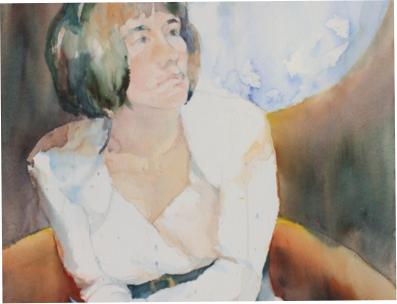
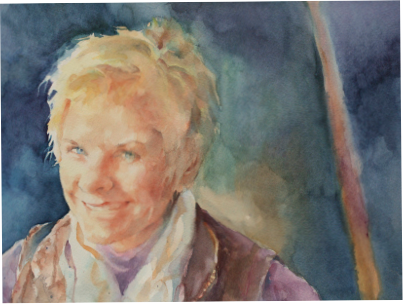
Good models are hard to find. Excellent models are downright rare, so finding an excellent model who connects with your muse is like a marine biologist finding a new pod of endangered whales. When you find one, it can spark a whole new series.
Which is what has happened. The young woman above is a local model and artist who is very good at what she does. I am so excited to have found her because when she and I are together, painting ideas spin off at an astonishing rate. With six paintings of her underway at the moment, I can safely say a series has been born.
I’ll let you know more as things progress.
Well, I will if you can pry me out of my studio.
- Details
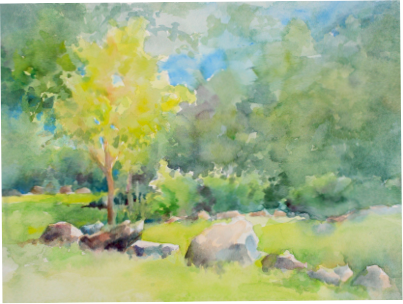
OK, here we go. We’re settled in, I’m meeting new maybe-friends, and joy of joys, only two boxes are left to unpack! It’s time to talk art!
The single biggest difference from Nevada to Massachusetts is the trees. There must be 400 different kinds in any square mile. That’s a lot of greens. It’s like Ireland or Great Britain: if you want to paint outside, you’d better learn your greens.
My friend and student Marcy passed on a workshop tip to us one day last year. Change color every half inch. That means your greens, too. Mix’ em, match ‘em, shift ‘em. It makes a huge difference
In this start, there are some patches of yellow-green that are pretty solid. Not to worry. I wanted them for a good, glowing base to help delineate shapes and guide the eye. I’ll be glazing over some of them later.
The rest of the painting already echoes Marcy’s advice. When I go in for the finish, large areas will remain as they are because they are a good value, they “say” trees, and they already have a good variety of greens to interest the eye.
Now you try it. Until next time,
Kate
- Details
It's amazing how quickly life can return to normal. It almost feels like there wasn't a huge storm last weekend. It also implies our life here has developed a "normal" mode again. I like that.
Cape Cod in the summer is inundated with visitors, so much so that the road system is really strained. High season only lasts for two months, though, so the roads are left unwidened, and stoplights are few and far between, at least on this part of the Cape. Of course, if they did "improve" the streets, even more tourists would come, and everyday business would be hard to conduct. Hmm. Maybe there's a method to their madness, eh?
The interesting thing about driving during high season is that the tourists all stay on two or three main routes. Backups and clogged intersections are expected unless you use the back roads. Which are amazingly uncluttered, so travel times are swift.
So why don't the tourists use them? Because leaving the main drag is kind of like aiming your car into a giant maze. If you don't know the right turns by sight, you get lost.
To those of us born and raised in the west, that just doesn't compute. I know it didn't for me, not until we arrived. Remember that trees are everywhere. Thickly. One stand of trees looks a lot like another when they are flashing by. Also, there are things we take for granted that don't exist here. Like the grid system and street signs at every intersection. Oh, and hey, if Thomas B. Landers Road shows on the map as a major road, it will be a major road on the ground, right?
Wrong. The streets here weren't planned ahead. They started as horse paths that ran from someplace where people lived to, say, a blacksmith shop or from a part of town to a meeting house. Point A to Point B along the straightest path offering the least resistance. Corners can be very sharp (horses corner well), and intersections can be complex and correspondingly dangerous.
Some roads that show up on the map are no more than ruts I'm sure not taking my low-slung Prius into. I've seen better 4-wheel-drive trails in the Rockies at 10,000 feet. Other, more major roads often intersect with what the maps show as minor roads, yet on the ground, the "main" road deteriorates to minor status, and the "minor" road is wide and well-maintained.
At major intersections, you will find a street sign for the road you want. Remember it well, as you won't see another until the next major intersection. Apparently, the theory is that since you turned onto the road, you know which road you are on, hence there is no need to tell you again. This works fine so long as you made the right turn in the first place. Things kind of fall apart if you weren't sure.
The answer? Make sure you have plenty of time when you start out, buy a 3G iPad and fork over the dough for 3G coverage, maintain a sense of humor, and don't shriek at your companions in your car.
Or you can stick to the main roads. Your choice.
Kate
- Details
We got our first goldfinch today! Those of you who visited my studio in Reno know that I love feeding the birds, especially goldfinches. Well, I finally got it together enough to buy some thistle seed and put out the single feeder I’ve been able to find. (The other two are down in the basement, because those are the only boxes left.) Then I waited. And waited. For four days. Sigh.
Then as I got ready to leave for our Grand Exploration daytrip to Gloucester, there was one little goldfinch chowing down. Yay!. So now I know things are almost back to normal.
We left immediately afterwards. Our mission? To boldly go where no person from this household has gone before. Also, to locate an Apple Store to cure my severe withdrawal symptoms and to scout out the main ring-road routes around/through Boston while all the Bostonians are away clogging the roads and beaches on-Cape.
Gloucester is a lovely fishing town that was first settled three years after the Mayflower reached Plymouth Rock. You know it as the Massachusetts Bay Colony from your history books. The countryside has a lot more hills and a great many more rocks than anyplace we’ve been on the Cape. We saw enough to know we’re going to come back when David has some time off built up and spend a few days. And yes, I will definitely have my paints with me.
I’m glad we braved Boston on a Sunday. There were still traffic backups and such, even with half the population celebrating Labor Day somewhere else. We drove close enough to the coast and airport to see what we think was Bunker Hill of Revolution fame from the highway...lots of old, interesting-looking buildings. We want to go back there, too.
So now we have a feel for the most obvious main highways and some plans for the future. Next time I write, I promise to get “back to basics”...painting, that is. I should have another finished painting or two by then.
Kate
- Details
We made it! Yay! The last half of the hurricane was worse than the first, which surprised me. The wind would back off for a while, crouching like a cat shuffling its back paws into a better position...shuffle again...once more for perfection and... POUNCE! The back off and repeat. This went on for a good five hours.
Fortunately, Irene was definitely losing steam by the time she got here. We had to eat by candle/flashlight, but the power came back on well before we had to worry about spoiled food. Nor did we need our bathtub full of water.
In the end, the wind did a one-eighty once we were on the backside of the whirlwind. That was hard on the trees. One TV announcer likened it to wiggling a tooth back and forth until it comes out. First the wind pushed one way, then another, and the loosened trees give way.
I really have to hand it to the emergency workers here; they were on the ball. Around here, that includes electricians, town maintenance workers, tree specialist companies, and people manning the shelters, and all sorts of other people I hadn't thought of before. Today, when I drove down to the plein aire group's meeting place, the main blockages had already been cleared or at least opened up.
Before the storm, the birds went silent. Interestingly enough, they were the ones who gave the "all clear." They started singing again while the wind was still doing about 20 mph with gusts around 40. Pretty smart for being "bird-brains," huh?
Tattered leaves lay like spent confetti in the woods and along road edges. Many of the trees have gone brown or bruised looking. A few were stripped.
Even so, with the sun slanting through a thinner canopy, it felt like a brand new day all day.
Kate
